
ORCHARD CREST JOURNAL
The World of Premium Cashews: Understanding Varieties, Sizes & Grades
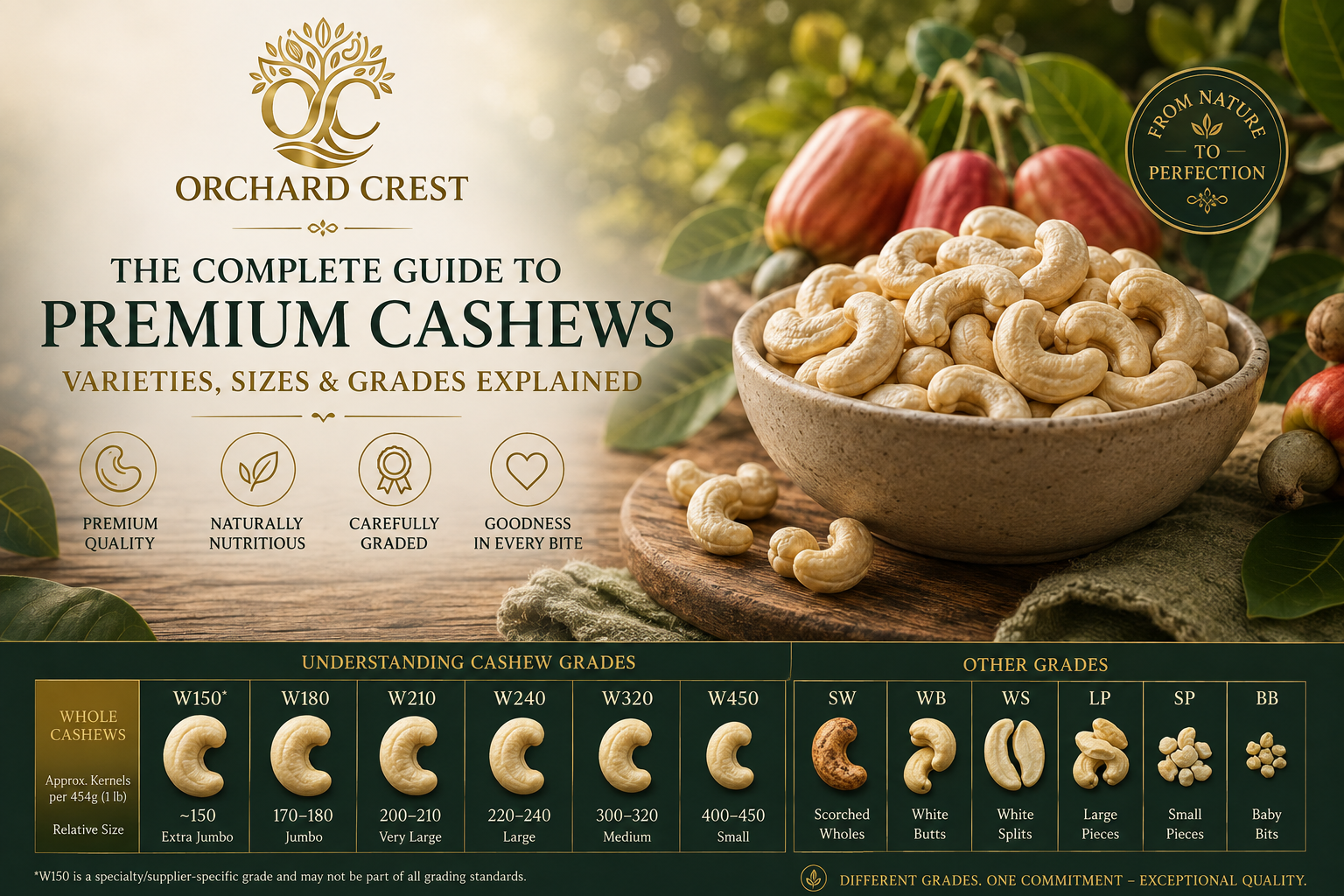
Cashew Grades Explained: W180, W210, W240, W320, W450 & More
Cashews are among the most popular dry fruits, loved for their creamy texture,
naturally rich flavour, and versatility. But when you shop for premium cashews,
you may come across terms such as W180, W210, W240, W320, W450, SW, WB,
WS and LP.
What do these numbers and letters actually mean?
The answer lies in the cashew grading system. Cashews are graded
primarily according to factors such as size, colour, shape, whole-kernel
integrity, processing quality and appearance.
Understanding these grades can help you choose the right cashews for everyday
snacking, cooking, premium gifting, or commercial use.
At Orchard Crest, we believe that premium dry fruits should not
only taste exceptional but should also be selected with knowledge and attention
to detail.
What Is Cashew Grading?
Cashew grading is the process of classifying cashew kernels
according to their physical characteristics.
The most familiar grades are:
- W180
- W210
- W240
- W320
- W450
The number generally refers to the approximate number of whole kernels per
454 grams (1 pound).
Lower Number = Larger Cashew Kernel
For example:
W180 → W210 → W240 → W320 → W450
As the number increases, the approximate number of kernels per pound increases,
meaning the individual kernels become smaller.
However, an important point to remember is that the grade number
indicates size; it does not automatically determine overall quality.
Freshness, colour, taste, processing, moisture, storage and appearance also
play an important role.
Understanding W180 Cashews
W180 is one of the most sought-after large whole cashew grades.
These kernels are exceptionally large and have an impressive appearance,
making them particularly popular for premium dry-fruit gifting,
luxury hampers, festive occasions and high-end snacking.
Because of their large size and visual appeal, W180 cashews are often positioned
as a premium selection.
Best Suited For:
- Luxury dry-fruit gifting
- Premium hampers
- Festive gifting
- Premium snacking
- Hospitality
Understanding W210 Cashews
W210 cashews are another premium large-kernel variety.
They are slightly smaller than W180 but still offer a substantial kernel size
and attractive appearance. W210 is a great option for consumers looking for
premium cashews that balance size, taste, appearance and value.
Best Suited For:
- Premium snacking
- Gifting
- Hospitality
- Roasting
- Culinary applications
Understanding W240 Cashews
W240 is a popular large whole-cashew grade that offers an
excellent combination of size and versatility.
W240 cashews are large enough to create an attractive premium presentation
while remaining suitable for everyday consumption and cooking.
They can be enjoyed roasted, salted or plain and are also widely used in
Indian sweets and desserts.
Best Suited For:
- Premium snacking
- Dry-fruit gifting
- Roasting
- Indian sweets
- Desserts
- Cooking
- Garnishing
For many consumers, W240 offers an excellent balance between kernel
size, appearance, taste and value.
Understanding W320 Cashews
W320 is one of the most popular and widely recognized cashew
grades.
The kernels are smaller than W180, W210 and W240 but remain whole, attractive
and highly versatile.
W320 cashews are particularly suitable for everyday consumption and are
commonly used in both household and commercial food applications.
Best Suited For:
- Everyday snacking
- Roasting
- Cooking
- Indian sweets
- Desserts
- Bakery products
- Gifting
The popularity of W320 comes from its combination of
consistent size, versatility and value.
Understanding W450 Cashews
W450 represents a smaller whole-kernel grade compared with
W320.
These cashews can be an excellent choice when extremely large kernels are not
necessary. They are suitable for everyday consumption as well as a variety of
culinary applications.
Depending on the supplier and market specification, you may also encounter
other grades such as W400 or W500.
These grades should be understood primarily as commercial size
classifications, rather than direct indicators of inferior or
superior taste.
Does W150 Cashew Grade Exist?
You may occasionally come across W150 cashews in commercial
markets or supplier specifications.
W150 generally refers to exceptionally large whole kernels. However,
W150 should not automatically be assumed to be part of every standard
cashew grading system.
Different suppliers and markets may use additional or specialized grades.
Therefore, when purchasing premium cashews, it is always useful to check the
actual supplier specification rather than relying solely on
the grade name.
What Does the “W” Mean in W320?
The W in grades such as W180, W210, W240 and W320 is commonly
associated with White Whole cashew kernels.
The term refers to whole kernels with a light, creamy or ivory appearance.
For example:
W320 = White Whole Cashews + approximately 320 kernels per pound
Similarly:
W240 = White Whole Cashews + approximately 240 kernels per pound
The grade therefore communicates both the kernel category and
approximate size.
What Are SW Cashews?
SW generally refers to Scorched Wholes.
These are whole cashew kernels that have a darker or scorched appearance
compared with white whole cashews.
You may encounter grades such as:
- SW180
- SW210
- SW240
- SW320
- SW450
The key distinction is that SW kernels remain whole, while
their colour or appearance differs from the lighter white whole category.
What Are WB and White Butts?
Cashew kernels can sometimes break during processing. These broken kernels
are classified according to their shape and size.
WB / B is commonly associated with White Butts.
Butts are kernels that have broken crosswise while retaining a recognizable
portion of the original kernel.
They are commonly used in:
- Indian sweets
- Desserts
- Bakery products
- Cooking
- Garnishing
What Are WS or White Splits?
WS / S refers to White Splits.
These are cashew kernels that have split lengthwise into two portions.
While they don’t have the same appearance as a whole cashew, they retain the
characteristic taste and nutritional qualities of cashew kernels.
They are useful for:
- Desserts
- Indian sweets
- Bakery
- Cooking
- Toppings
What Are LP and LWP Cashew Pieces?
LWP generally means Large White Pieces, while some suppliers
may use LP (Large Pieces) as a shorthand.
These are relatively large pieces of cashew kernel created during processing.
Large cashew pieces are particularly useful when whole-kernel appearance is
not essential.
Common Uses Include:
- Kaju katli
- Indian sweets
- Desserts
- Bakery products
- Trail mixes
- Cooking
- Food manufacturing
What Is SWP Cashew Grade?
SWP stands for Small White Pieces.
These are smaller white cashew pieces that can be used in food preparation,
bakery products and other applications.
They offer the familiar taste of cashews while being particularly practical
for recipes where whole kernels are not required.
What Are BB or Baby Bits?
BB, commonly referred to as Baby Bits, describes very small
cashew fragments.
These pieces can be useful in:
- Cashew paste
- Cashew butter
- Confectionery
- Bakery
- Food processing
Although small in size, they can still contribute the rich, creamy flavour
associated with cashews.
Scorched Broken Cashew Grades
Scorched cashews can also be classified according to their shape and size.
| Grade | Meaning |
|---|---|
| SB | Scorched Butts |
| SS | Scorched Splits |
| SP | Scorched Pieces |
| SSP | Scorched Small Pieces |
These classifications combine the scorched colour category
with the physical form of the kernel.
Complete Cashew Grades Chart
| Grade | Full Description | General Characteristics |
|---|---|---|
| W150* | White Whole | Extra-large specialty kernels |
| W180 | White Whole | Jumbo / very large |
| W210 | White Whole | Very large |
| W240 | White Whole | Large |
| W320 | White Whole | Medium / popular |
| W400* | White Whole | Smaller |
| W450 | White Whole | Small |
| W500 | White Whole | Very small |
| SW | Scorched Whole | Whole kernels with darker appearance |
| WB / B | White Butts | Crosswise broken kernels |
| WS / S | White Splits | Lengthwise split kernels |
| LWP / LP | Large White Pieces | Large cashew pieces |
| SWP | Small White Pieces | Small cashew pieces |
| BB | Baby Bits | Very small pieces |
| SB | Scorched Butts | Scorched broken butts |
| SS | Scorched Splits | Scorched split kernels |
| SP | Scorched Pieces | Scorched pieces |
| SSP | Scorched Small Pieces | Small scorched pieces |
| DW | Dessert Wholes | Dessert-grade whole kernels |
| DB | Dessert Butts | Dessert-grade butts |
| DS | Dessert Splits | Dessert-grade splits |
| DP | Dessert Pieces | Dessert-grade pieces |
*W150 and some additional grades may be encountered in specific supplier or
market specifications and should be verified against the applicable
commercial specification.
Are Bigger Cashews Always Better?
Not necessarily.
A common misconception is that W180 is automatically a higher-quality
cashew than W320 simply because it is larger.
The W-number primarily communicates kernel size/count.
Overall cashew quality depends on several factors, including:
- Size: The grade indicates the approximate kernel count and size.
- Colour: White, scorched and dessert categories indicate differences in appearance.
- Shape: Whole, butts, splits and pieces describe the physical integrity of the kernel.
- Freshness: Fresh cashews should have a pleasant aroma, characteristic flavour and crisp texture.
- Processing: Proper shell removal, peeling, drying, sorting and handling are essential.
- Storage: Proper storage helps protect cashews from moisture, oxidation and deterioration.
- Uniformity: Premium cashews benefit from consistent size, colour and appearance.
Cashew grade is one part of quality—not the entire definition of quality.
Which Cashew Grade Should You Choose?
For Premium Gifting: W180 & W210
If appearance and large kernel size are priorities, W180 and W210
are excellent choices for luxury dry-fruit hampers and premium gifting.
For Premium Everyday Snacking: W240
W240 offers a generous kernel size and excellent versatility,
making it an attractive choice for premium snacking.
For Everyday Use: W320
W320 is an excellent all-rounder for snacking, cooking,
roasting, sweets and desserts.
For Recipes & Food Processing: W450 & Broken Grades
Smaller whole kernels and broken grades can be particularly practical for
recipes and food applications where the appearance of an intact kernel is
less important.
Mangalore & Udupi Cashews: Does Origin Matter?
The coastal Karnataka regions of Mangaluru (Mangalore) and Udupi
have a long association with cashew cultivation and processing.
Cashews associated with these regions are valued for their place within India’s
established cashew-growing and processing tradition.
However, it is important to understand that origin alone does not
determine cashew grade or quality.
A premium cashew is the result of multiple factors:
Origin + Cultivation + Processing + Size + Colour + Freshness + Storage
At Orchard Crest, we believe in evaluating the complete quality profile rather
than relying on a single characteristic.
How Orchard Crest Selects Premium Cashews
At Orchard Crest, our philosophy is simple: premium dry fruits
should be carefully chosen, not simply commercially graded.
We look at the complete experience—from appearance and size to freshness,
texture, taste and consistency.
Whether it is the impressive size of W180, the premium balance
of W210, the versatility of W240, or the
everyday appeal of W320, every grade has a distinct purpose.
Our goal is to help you enjoy cashews that are not only visually appealing but
also deliver the taste, freshness and quality you expect from
a premium dry-fruit brand.
From Orchard to Your Table
Every cashew begins its journey with nature.
From cultivation and harvesting to processing, grading, sorting and storage,
countless details contribute to the final kernel that reaches you.
At Orchard Crest, we celebrate that journey by focusing on
quality and careful selection.
Because when it comes to premium cashews,
the difference is not just in the grade—it is in the care behind every kernel.
Orchard Crest
Premium Dry Fruits. Carefully Chosen.