
ORCHARD CREST JOURNAL
Almond Varieties Explained: California, Mamra, Iranian & Gurbandi Almonds
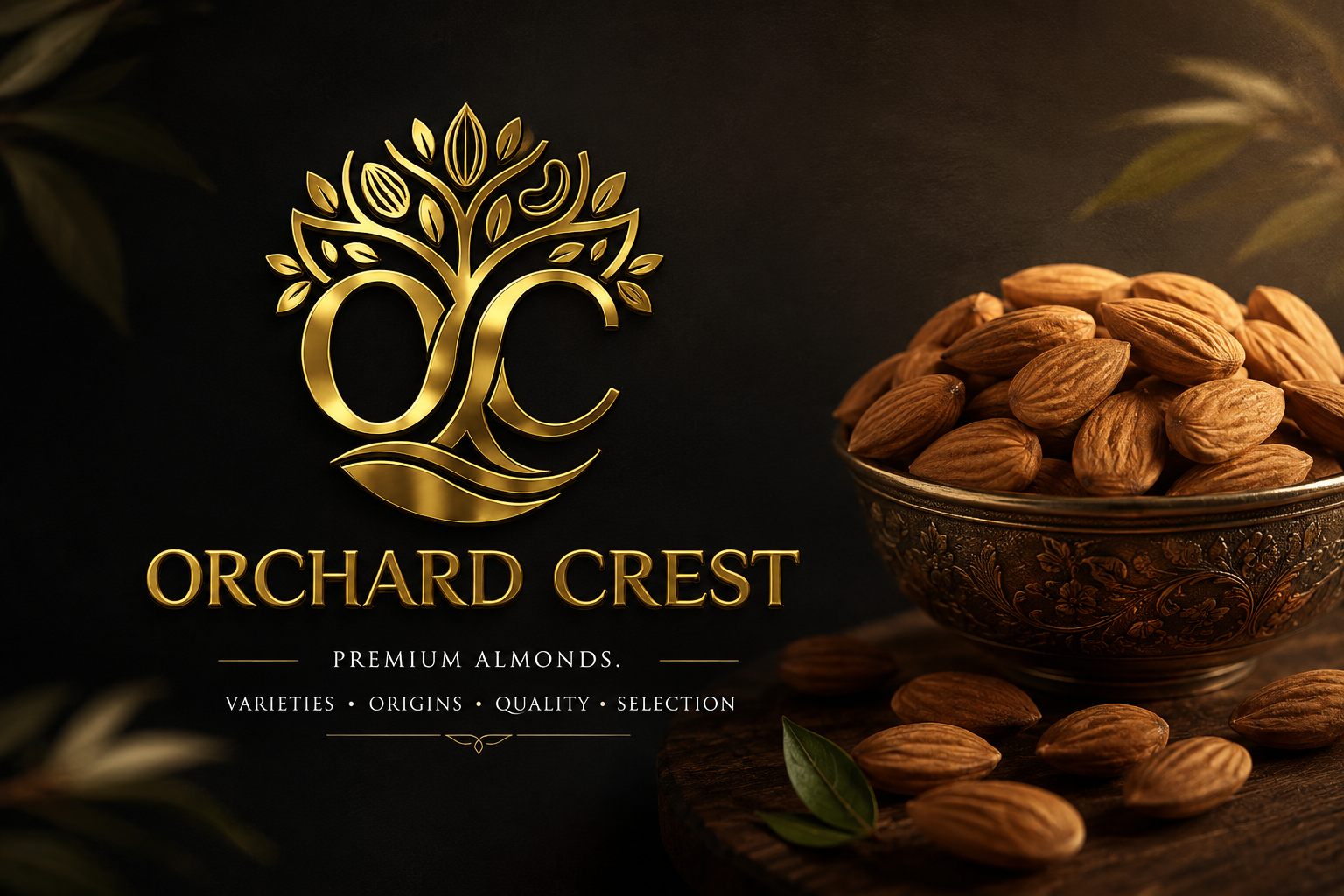
Almonds are among the most popular dry fruits, but not all almonds are the same.
Their variety, region of origin, size, shape, texture, flavour and freshness
can differ considerably.
From the familiar California almond to the distinctive
Iranian Mamra, each type has its own characteristics.
Understanding these differences helps you make a more informed choice,
especially when selecting almonds for premium snacking or gifting.
At ORCHARD CREST, we believe that premium quality begins
with knowing what is inside the pack.
California Almonds
California is one of the world’s leading almond-producing regions and is
known for several commercial varieties, including
Nonpareil, Carmel, Monterey, Butte and Padre.
Among these, Nonpareil is particularly well known for its
attractive appearance. It generally has a
smooth, light-coloured skin, uniform shape and relatively thin shell,
making it popular for whole-kernel consumption, premium presentation and gifting.
Other California varieties, such as Carmel, Monterey, Butte and Padre,
can differ in shape, skin texture and intended use.
California almonds are generally appreciated for their
consistent quality, attractive appearance, mild flavour and versatility.
Iranian Almonds & Mamra
Iran has a long history of almond cultivation and is known for considerable
diversity in almond types. Among the varieties associated with the premium
dry-fruit market, Mamra almonds are especially sought after.
Mamra-type almonds are typically
smaller, more irregular and naturally curved compared with
the larger, more uniform California almonds. They are valued for their
distinctive aroma, rich flavour and characteristic texture.
Iranian describes the origin; Mamra describes the almond type.
Therefore, not every almond from Iran should automatically be called Mamra.
Reliable sourcing and traceability are important when purchasing premium
Mamra almonds.
Gurbandi Almonds
Gurbandi almonds are another smaller almond type commonly
associated with Afghanistan and surrounding markets.
They may appear similar to Mamra because of their relatively small and
irregular kernels. However, Gurbandi and Mamra should not be treated
as interchangeable names.
For consumers, the key is to purchase from a supplier that can clearly
communicate the variety and origin rather than relying only on appearance.
Specialty Almonds from Other Regions
Almond diversity extends beyond California and Iran.
Marcona almonds from Spain, for example, are known for their
distinctive rounded shape and rich, gourmet character. Other Spanish varieties,
as well as almonds grown in Australia and other regions, offer their own
combinations of shape, flavour and texture.
This highlights an important point:
The origin and variety of an almond can tell you much more than its size alone.
What Makes an Almond Premium?
A premium almond is not necessarily the biggest or most expensive one.
Several characteristics should be considered together.
1. Appearance
Look for almonds that are clean, intact and healthy-looking,
with minimal insect damage, mould, excessive shrivelling or unusual
discoloration.
Natural variation is perfectly normal, particularly in varieties such as Mamra.
2. Size & Uniformity
Uniform, larger kernels are often preferred for
premium presentation and gifting, while smaller varieties
can have their own distinctive appeal.
Therefore, size should be considered according to the variety,
rather than used as the only measure of quality.
3. Freshness
Freshness is one of the most important indicators of almond quality.
Fresh almonds should have a pleasant, clean and naturally nutty aroma.
If an almond smells musty, stale, paint-like or rancid, it may have
deteriorated due to age or improper storage.
4. Taste
A high-quality almond should have a
clean, pleasant nutty flavour, with a naturally sweet
and characteristic finish.
An unpleasant bitter, stale or rancid taste is a warning sign.
5. Texture
Fresh almonds should have the characteristic crisp or firm texture
expected from their variety.
Almonds that feel excessively soft, rubbery or stale may have been exposed
to moisture, heat or prolonged storage.
6. Origin & Traceability
For premium almonds, knowing where the almonds were grown and what
variety they are adds important context.
A trustworthy supplier should be able to provide clear information about
origin and product specifications wherever available.
California vs. Mamra: Which Should You Choose?
There is no universal answer.
California Nonpareil is an excellent choice when you want
uniformity, attractive appearance, mild flavour and versatility.
Mamra-type almonds are appealing when you prefer a
smaller, naturally irregular almond with a distinctive and richer
flavour profile.
The choice ultimately depends on your preference and intended use.
| Feature | California Nonpareil | Mamra-Type |
|---|---|---|
| Appearance | Larger & uniform | Smaller & irregular |
| Skin | Generally lighter & smooth | Often darker & textured |
| Flavour | Mild & clean | More pronounced |
| Texture | Crisp | Dense/rich character |
| Presentation | Highly uniform | Naturally rustic |
| Positioning | Premium commercial | Specialty premium |
Does Bigger Mean Better?
Not necessarily.
A large almond may offer excellent visual appeal, but size alone does not
determine freshness, flavour or nutritional quality.
Likewise, smaller almonds such as Mamra-type almonds should not be considered
inferior simply because they are less uniform.
True quality comes from the combination of variety, origin, freshness,
appearance, flavour and careful handling.
The ORCHARD CREST Standard
At ORCHARD CREST, we believe premium dry fruits should be
selected with attention to the details that matter.
From the carefully selected California almond to the
distinctive Mamra-type almond, every variety has its own identity.
We look beyond labels such as premium or extra quality
and focus on what truly matters:
- Authentic variety
- Known origin
- Freshness
- Clean appearance
- Excellent taste
- Careful selection
Because a premium almond isn’t simply one that looks good.
It is one that delivers the quality and experience you expect from it.